 English
  Spanish
  French
  German
  Russian
  Japanese
  Korean
  Portuguese
 A formulator developing a two-component electronic potting compound may ask for vinyl silicone fluid, hydride silicone fluid, platinum catalyst, inhibitor and silicone resin in the same inquiry. These materials belong to the same formulation, but they do not perform the same job. Confusing a linear silicone fluid with a three-dimensional MQ resin can lead to the wrong grade comparison before laboratory testing even begins.
Filename: hydride-fluid-vs-vinyl-mq-resin-potting.jpg
Alt: Hydride silicone fluid and vinyl MQ resin roles in an addition-cure potting formulation
What does hydride silicone fluid do in a potting formulation?
Addition curing is based on hydrosilylation between vinyl-functional silicone and Si-H-functional material in the presence of a platinum catalyst. The hydride component is therefore part of the cure chemistry rather than an inert filler or general-purpose resin.
For a two-component system, formulators normally evaluate the hydride material together with the vinyl polymer, catalyst, inhibitor and filler package. The useful comparison is not simply one product viscosity against another. Si-H content, Si-H position, functionality, compatibility and the target Si-H-to-vinyl balance all influence the resulting network.
The XJY hydrogen silicone fluid range includes several structures for addition-cure and reactive-modification work. Relevant options include XJY-702, XJY-707 and XJY-711, but their structures make them suitable for different formulation roles.
XJY-702: pendant Si-H crosslinker
XJY-702 methylhydrosiloxane-dimethylsiloxane copolymer contains pendant Si-H functionality and is positioned as a crosslinking material for addition-cure liquid silicone systems.
XJY-711: mixed hydride functionality
XJY-711 hydride-functional copolymer is documented as a special crosslinker for liquid silicone.
XJY-707: terminal Si-H
XJY-707 hydride-terminated PDMS is especially relevant as a chain extender and network-adjustment material.
How should XJY-702 be evaluated?
Because pendant Si-H groups can create multiple connections along the polymer chain, XJY-702 is the logical starting family when a project specifically calls for a conventional side-hydride crosslinker. Different grades allow formulators to evaluate hydrogen content and viscosity against the required cure response and mechanical profile. Grade selection still requires the vinyl polymer specification and a calculation of the reactive-group ratio.
When is XJY-711 relevant?
The available XJY-711 specification lists clear-liquid grades with hydrogen contents of 0.45%, 0.75% and 1.00%, paired with different viscosity ranges. This family can be considered when a formulator needs a hydride structure different from a purely pendant or purely terminal material. It should be screened in the actual formulation rather than treated as a universal substitute for another crosslinker.
Why is XJY-707 different?
XJY-707 carries reactive hydrogen at the ends of a linear PDMS chain. Compared with a multifunctional pendant-Si-H crosslinker, a terminal-hydride fluid generally contributes differently to crosslink density. It can be evaluated when the formulation team is adjusting flexibility, toughness, elongation or hardness, but it should not automatically replace the main crosslinker on a one-for-one basis.
Filename: xjy-hydride-silicone-fluid-selection.jpg
Alt: Pendant and terminal hydride silicone fluid structures for formulation screening
What does vinyl MQ resin contribute?
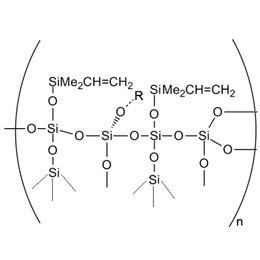
Vinyl MQ resin is not another name for vinyl-terminated silicone fluid. A vinyl silicone fluid is predominantly a linear polymer and commonly serves as the base polymer in an addition-cure formulation. MQ resin has a branched, three-dimensional siloxane structure built from M and Q units. When vinyl functionality is present, the resin may also participate in the cure network.
The main formulation reason to evaluate vinyl MQ resin is reinforcement and network modification. Depending on the grade, loading and compatibility, it may be used to explore greater firmness, mechanical reinforcement or dimensional stability. These results must be confirmed in the complete compound because the resin does not independently determine final hardness, thermal conductivity or flame performance.
The XJY methyl vinyl MQ silicone resin range gives formulators two practical incorporation routes:
- XJY-8206 powder grades provide direct control over the resin and silicone-fluid ratio. XJY-8206 vinyl MQ resin is positioned for reinforcement in addition-cure silicone development.
- XJY-8206N liquid grades combine methyl vinyl MQ resin with vinyl polydimethylsiloxane. This supplied liquid form can reduce the separate powder-dissolution step when it fits the intended formulation route. See the XJY-8206N resin-fluid blend.
Why must filler information come before grade selection?
An electronic potting inquiry often begins with a target mixed viscosity, gel time, cure schedule and Shore hardness. Those targets are useful, but they are not enough to select the reactive silicone materials when the filler package is unknown.
The formulation team should first document:
- Filler chemistry, loading, particle-size distribution and surface treatment.
- Whether the stated filler percentage applies to one component or to the final A/B mixture.
- Vinyl content and viscosity of the base silicone polymer.
- Required working time, cure temperature and cure depth.
- Target hardness, flexibility and reworkability.
- Required thermal conductivity and electrical properties, including the applicable test methods.
- Flame-retardancy target and whether certification applies to the final compound.
Filler selection can dominate flow, settling, thermal transfer and flame behavior. For example, a formulation described only as “60% filled” does not reveal whether the filler is calcium carbonate, alumina, aluminum hydroxide or another functional mineral. The same hydride grade may behave differently as viscosity, surface chemistry and filler moisture change.
Filename: electronic-potting-filler-evaluation.jpg
Alt: Evaluation factors for fillers in electronic silicone potting compounds
Can a raw material guarantee UL 94 V-0 or thermal conductivity?
The final result depends on the base polymer, reactive-group ratio, catalyst and inhibitor levels, filler chemistry, additives, dispersion, specimen thickness, conditioning and test method. A raw-material supplier can recommend candidates and provide specifications, but the formulated compound must be tested and, where required, certified in its final configuration.
A practical screening sequence
- Define the vinyl polymer and filler package.
- Calculate an initial Si-H-to-vinyl ratio.
- Select a pendant or mixed-functionality hydride crosslinker, such as an appropriate XJY-702 or XJY-711 candidate.
- Evaluate XJY-707 separately if chain extension or network softening is required.
- Add vinyl MQ resin only when reinforcement or firmness is an explicit development objective.
- Adjust catalyst and inhibitor levels around the required pot life and cure schedule.
- Test viscosity, gel time, hardness, thermal properties, electrical properties and flame behavior on the complete formulation.
Select the material by function
Hydride silicone fluid and vinyl MQ resin can work in the same addition-cure potting formulation, but they are not interchangeable. XJY-702 and XJY-711 provide crosslinker options, XJY-707 provides a terminal-hydride route for chain and network adjustment, and the XJY-8206 family provides vinyl MQ resin options for reinforcement development.
Discuss your formulation with XJY Silicones
Share your base-polymer specification, filler type, target properties and processing conditions. Our team can help identify relevant hydride silicone fluid and vinyl MQ resin candidates for laboratory evaluation. Final performance should always be validated in the complete formulation.