 English
  Spanish
  French
  German
  Russian
  Japanese
  Korean
  Portuguese
 XJY-8206F is a candidate for this evaluation. Its documented identity is methyl vinyl MQ silicone resin, supplied as a white powder with a listed vinyl content of 0.8–1.2%. These properties support grade screening; they do not establish a dosage or guarantee performance in a particular silicone formulation. Confirm compatibility and processing conditions for your base system before preparing trials.
Start with the Formulation Problem
A recent inquiry raised a specific question: how could a silicone described as approximately 10A hardness gain tear resistance while remaining transparent after the resin dissolved? The proposed trial approach was to add small portions gradually and allow time for dissolution. A sample was sent for evaluation, but test feedback is still pending. This is an evaluation question, not a completed performance case.
For a similar project, translate the request into measurable requirements before selecting a resin loading. Confirm what the hardness designation means, the measurement method, and the permitted range. Define whether “transparent” refers to the uncured mixture, the cured part, or both. Agree on the tear test and the improvement needed for the intended application.
Without those definitions, a harder sample or a visually clear mixture could be mistaken for a successful formulation.
Why Evaluate Vinyl MQ Resin?
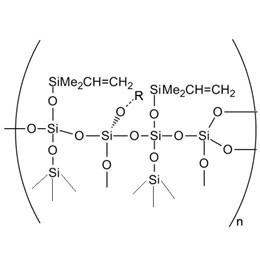
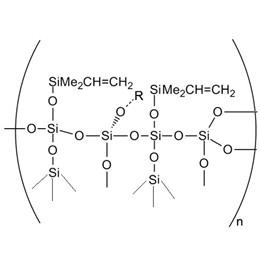
MQ silicone resins contain monofunctional M units and tetrafunctional Q units. Vinyl-functional MQ resin also carries reactive vinyl groups. In a platinum-catalyzed addition-cure silicone system, these groups can participate in hydrosilylation with Si–H groups from a hydrogen-containing silicone crosslinker, incorporating the resin into the cured network.
That chemistry makes reinforcement worth investigating, but it also means the resin should be considered in the cure design. Do not assume that adding a reactive resin leaves the original formulation balance unchanged. Ask the technical team to review the vinyl contribution from both the base polymer and resin, together with the crosslinker information.
For background on the material families, see what distinguishes methyl MQ resin from vinyl MQ resin.
What Is Verified for XJY-8206F?
The XJY MQ resin brochure identifies XJY-8206F as methyl vinyl MQ silicone resin powder and lists its vinyl content as 0.8–1.2%. The XJY-8206 product specification table gives the same range and identifies E/F grades with transparent low-hardness silicone rubber and silicone gel applications.
This positioning is a reason to evaluate the grade. It does not demonstrate that XJY-8206F will dissolve transparently in every carrier, maintain a particular hardness, or deliver a specified tear-strength increase. Request current grade documentation and sample-specific information before finalizing the trial.
Check Dissolution Before Comparing Cured Properties
Define the Base System
Record the base polymer or silicone fluid, existing fillers and additives, and the cure system. Share this information with the supplier so that a suitable incorporation route can be discussed. The methyl vinyl MQ silicone resin category provides an overview of the available product family.
For a two-component material, document which component receives the resin and obtain a formulation-specific recommendation before changing the mixing procedure. A process that works in one base system is not automatically transferable to another.
Treat Gradual Addition as a Trial Variable
The inquiry’s small-portion, gradual-dissolution approach can be assessed in a controlled laboratory trial after the carrier and processing route have been confirmed. It is not a validated XJY-8206F processing specification.
Record each addition and the appearance of the mixture before proceeding. If visible particles, haze, or separation remain, document the observation and review the method with the supplier. Avoid assigning a universal mixing speed, temperature, or dissolution time without supporting instructions for the actual formulation.
Assess Clarity at Both Stages
Inspect the uncured mixture and the cured specimen separately. Use consistent containers or specimen thicknesses, lighting, and backgrounds for comparisons. Record particles, bubbles, haze, color, and any separation as separate observations.
Where optical performance is a product requirement, agree on an instrumental method and an acceptance limit. A visual check alone should not be reported as measured light transmission, and a clear uncured mixture does not establish the cured part’s optical performance.
Build a Low-Hardness Silicone Tear Strength Trial
Start with a reference batch of the current formulation. Select trial resin levels with the technical team, and document whether each formulation also needs a cure-balance adjustment. Keep a complete record of every change so that the results can be interpreted.
| Evaluation | Record for every formulation | Decision it supports |
|---|---|---|
| Incorporation | Addition sequence, mixing conditions, time, visible residue and mixture appearance | Can the resin be incorporated consistently? |
| Cure behavior | Component ratio, processing window, cure schedule and observed cure condition | Is the trial suitable for the intended process? |
| Hardness | Method, scale, specimen preparation, reading conditions and result | Does the material remain within the softness requirement? |
| Tear strength | Method, specimen geometry, thickness, conditioning, test settings and individual results | Is the comparison valid and the improvement repeatable? |
| Transparency | Uncured and cured observations; optical method and result where required | Does the formulation meet the agreed appearance requirement? |
| End-use behavior | Relevant part geometry and application-specific checks | Does the laboratory candidate work in the intended part? |
Choose Test Methods Before Making Samples
ASTM D624 addresses tear strength of conventional vulcanized rubber and thermoplastic elastomers. ASTM D2240 addresses durometer hardness. Ask the testing laboratory to confirm the applicable method, instrument, specimen requirements, and current procedure for your material.
Use the same agreed tear-test configuration for reference and candidate specimens. Record the geometry rather than reporting only “tear strength.” For a material near the low end of a hardness scale, have the laboratory confirm that the selected measurement approach is appropriate. Do not convert the customer’s “10A” description into a verified test result.
Repeat the comparison sufficiently to assess consistency under your laboratory’s procedure. Report individual results and variation alongside any summary value. This guide specifies no resin loading, cure temperature, mixing speed, or numerical performance target because those inputs require formulation-specific validation.
Interpret the Results Against All Three Requirements
If tear strength improves while hardness exceeds the permitted range, the formulation has not yet met the brief. Review the formulation and cure design before calling the trial successful.
If softness remains acceptable but clarity fails, review the incorporation observations and optical results. Distinguish undissolved material, bubbles, and other visible changes before choosing the next experiment. These observations identify questions to investigate; they do not establish the cause on their own.
If all laboratory requirements are met, confirm the result in the intended part and process before approving the formulation. If improvement is absent or inconsistent, share the full trial record with the technical team rather than assuming that more resin will solve the problem.
Request an XJY-8206F Evaluation Sample
Planning to evaluate vinyl MQ resin in a soft, transparent silicone formulation? Send XJY Silicones your base-system description, hardness method and target, tear-test requirement, clarity criteria, and current processing route.
Use Contact Us to request current XJY-8206F documentation, discuss an evaluation sample, or obtain a quotation. Include the limitations of the existing formulation so that the discussion can focus on a practical trial plan.