 English
  Spanish
  French
  German
  Russian
  Japanese
  Korean
  Portuguese
 In the healthcare industry, traditional ointments, gels, and physical plastic patches have always dominated wound care and topical treatments. However, ointments are easily rubbed off, while physical patches often cause skin stuffiness, irritation, or tearing pain upon removal. Today, a revolutionary drug delivery method is transforming the medical industry—In Situ Film-Forming Systems (FFSs).
This technology, commonly known as “smear-on liquid bandages,” rapidly evaporates and cures after being applied to the skin, forming an almost invisible protective film. It is not only aesthetically pleasing, waterproof, and friction-resistant, but it also creates a supersaturated state of the drug on the skin surface, greatly promoting the transdermal absorption of active ingredients into the human body.
In this “drug delivery revolution,” medical-grade silicone has become the “core code” determining the quality of the film. This article will deeply explore semi-solid in situ film-forming systems containing silicones, discuss the broader applications of medical silicone, and reveal how to create the perfect medical skin patch using the Quality by Design (QbD) concept.

Why Introduce “Medical Grade Silicone” into Film-Forming Systems?
When developing in situ film-forming systems, the biggest challenge medical device manufacturers and formulators face is balancing “fast drying,” “firm adhesion,” and “skin comfort.”
Unlike conventional silicone or rigid plastic, medical-grade silicone is hypoallergenic, non-reactive, and highly biocompatible, making it a safer option for use in medical applications. Adding specialty silicone materials—such as volatile cyclomethicones, medical grade silicone resin (like Trimethylsiloxysilicate), and low viscosity dimethicone—brings irreplaceable advantages:
Ultimate Biocompatibility and Safety: Medical-grade silicone is certified to be non-toxic, non-allergenic, and non-reactive with human tissue and body fluids. It acts as an effective barrier on the skin or mucous membrane without causing immune responses.
“Silky” Touch & Flexibility: Eliminates the dragging sensation of traditional polymers. The soft, flexible nature of medical-grade silicone allows films and medical devices to conform to the body’s contours, reducing the risk of sores from long-term wear.
Exceptional Chemical Resistance: Medical-grade silicone is chemically inert and resistant to bodily fluids, oils, and commonly used cleaning agents. It ensures the drug film remains stable when sweating or exposed to moisture.
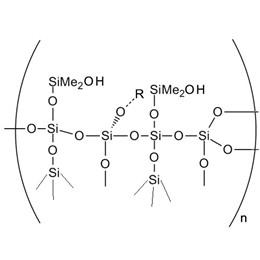
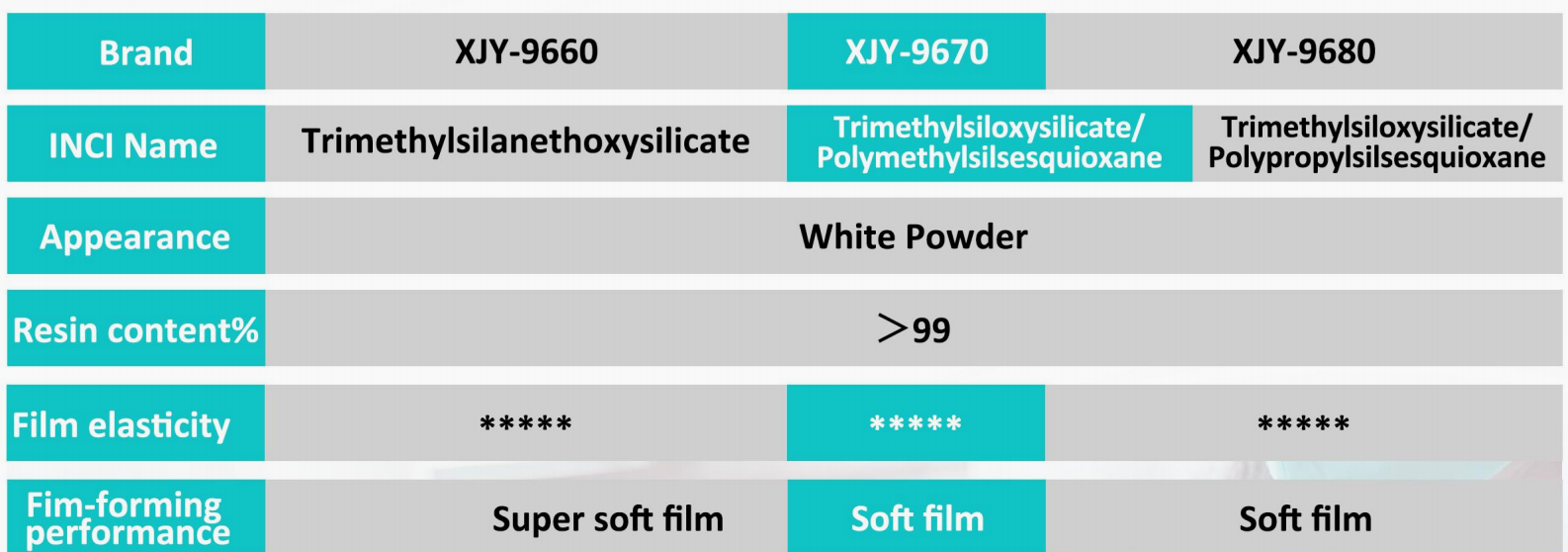
XJY-9660/9670/9680 Trimethylsiloxysilicate is a siloxane polymer with a main chain structure consisting of alternating silicon and oxygen atoms. These solid silicone resins provide film-forming and softening effects, which provide excellent water repellency and detergent/water wash resistance for many pharmaceutical formulations.
Accurately Targeting the Indicators of the “Perfect Drug Film”
Modern pharmaceutical and device R&D is no longer a guessing game but adopts the systematic approach of QbD (Quality by Design). Through a Risk Estimation Matrix (REM) and rigorous testing protocols, the research team identified several Critical Quality Attributes (CQAs):
High-Criticality Indicators (Category A):
Skin Adhesion: Determines how long the film stays attached to the body.
Film Flexibility: Determines whether the film will pull the skin or crack. Medical-grade silicone maintains flexibility and structural integrity across a massive temperature range (typically -60°C to +270°C).
Burst Strength: Determines the cured rubber film’s ability to resist external physical damage, requiring high tear strength.
Moderate-Criticality Indicators (Category B):
Film Appearance, Integrity, and Cure Time (Drying Time).
To meet these CQAs, medical-grade silicones comply with stringent standards, including FDA 21 CFR, USP Class VI, and ISO 10993 for biocompatibility.

How Does Silicone Resin Content Change Film-Forming Performance?
To find the optimal formulation, researchers compared three different systems: F1 (silicone-free), F2 (containing 25% silicone composite), and F3 (containing 50% silicone composite).
- Skin Adhesion: Stickier isn’t always better
A good liquid patch needs to adhere firmly but must absolutely not cause pain when peeled off.
The silicone-free formulation (F1) had an average peel force of 157 mN, making it harder to remove.
The 25% silicone formulation (F2) had a peel force of 131 mN, achieving an ideal balance.
The 50% silicone formulation (F3) saw peel force plummet to 19 mN, which could lead to premature detachment.
- Flexibility and Resilience: Creating an “Artificial Epidermis.”
Experiments show that systems with an appropriate amount of liquid silicone better conform to skin texture. The F2 (25% silicone) formulation demonstrated excellent deformation resistance, providing a premium feel comparable to the natural elasticity of the skin.
- The Curing Process and Drying Time: The Platinum Cure Advantage
This is where medical-grade silicone shows absolute dominance. The curing process is the deciding factor for patient experience.
The silicone-free F1 formulation took nearly 15 minutes to dry.
The F2 formulation reduced this time to 10 minutes.
The F3 formulation achieved surface drying in just 6 minutes!
Furthermore, high-end medical formulations rely on addition cure (also known as platinum cure silicones). The curing process for medical-grade silicone typically uses a platinum-cure system, which avoids the production of harmful byproducts, unlike conventional silicone, which may use a peroxide curing system. This ensures maximum safety and eliminates any potential for skin irritation. Note that when formulating, one must avoid cure inhibition, which occurs if the platinum catalyst contacts sulfur or amines.

The Landscape of Medical Silicone Manufacturing
While in-situ film-forming systems (utilizing liquid resin and a solvent base) represent the cutting edge of topical treatments, medical-grade silicone is a highly versatile material that goes far beyond liquid bandages. Silicone can be categorized into three main categories: Liquid Silicone Rubber (LSR), High Temperature Vulcanized (HTV) silicone, and Room Temperature Vulcanized (RTV) silicone.
For the production of solid medical devices, Liquid silicone rubber (LSR) is a highly flexible thermosetting polymer that is increasingly used in the manufacture of medical products due to its superior properties such as biocompatibility, heat resistance, and chemical stability.
Producing medical-grade silicone products requires advanced techniques:
Injection Molding: LSR is processed at extreme temperatures and is often used in liquid injection molding, making it suitable for producing high-precision medical components with tight tolerances.
Compression Molding: Compression molding is a common method used in the production of medical-grade silicone parts, where a pre-measured amount of silicone is placed in a heated mold and then compressed to form the desired shape.
Overmolding: Adding a soft layer of silicone over existing parts to enhance grip and comfort.
Through precise mold design and mold making, product designers utilize silicone molding to manufacture a broad range of silicone products. These range from long-term implantable devices and respiratory tubing to everyday items like menstrual cups and dental seals.
Unlike food-grade silicone, which focuses primarily on basic food safety, medical-grade silicone is ultra-pure and free from harmful additives, plasticizers, or fillers, and is frequently produced in cleanroom environments to prevent contamination. Moreover, it is designed to maintain its integrity after repeated exposure to sterilization methods like autoclaving, UV light, gamma radiation, and ethylene oxide.
Finding the Right Solution with Premium Silicone Materials
Whether you are developing a novel topical scar gel, a breathable wound dressing, or structural devices through liquid silicone rubber casting, silicone is undeniably the “Golden Formula” of the next generation.
From producing medical-grade silicone resins that provide waterproof, breathable microscopic networks, to supplying raw materials for high-volume silicone molding, quality is non-negotiable. Many manufacturers are realizing that transitioning from conventional silicone to ultra-pure, platinum-cured grade silicone is the only way to meet stringent global health regulations.
As a leading silicone manufacturer, we provide the expertise needed to navigate this complex field. If you are looking to optimize your FFS formulations or want to buy medical-grade silicone designed for peak performance and safety, please contact our technical experts to find the right solution for your next medical innovation!