 English
  Spanish
  French
  German
  Russian
  Japanese
  Korean
  Portuguese
 Why can foundation or skin care still feel dry or look uneven after powder is added? Conventional fillers may improve coverage, but excessive loading increases powderiness and poor dispersion creates agglomerates. XJY-805 and XJY-806 silicone hybrid powders address this problem with micron-scale particles and a soft, smooth sensory profile.
Silicone hybrid powder is a cosmetic texture modifier for spreadability, soft focus and adhesion. XJY-805 and XJY-806 are white 5–7 μm powders for makeup and skin care. Their different chemistries support selection by sensory target, oil compatibility and final-formula tests.
Why Can Conventional Cosmetic Powders Make Makeup Feel Dry?
Mineral fillers such as silica deliver absorption, coverage and flow. However, high loading may increase friction, interfere with product layering or reduce the velvety texture expected from beauty products.
Agglomeration can change viscosity, pigment distribution and the final silky finish. Particle shape, molecular structure and compatibility with oils and waxes matter as much as dosage.
What Is a Silicone Hybrid Powder in Cosmetics?
A silicone hybrid powder for cosmetics is a crosslinked composite particle combining softness with powder handling. Silicone polymers are synthetic materials built around silicon and oxygen; silicon occurs in nature, including silica and sand.
Unlike volatile fluids, XJY-805 and XJY-806 are non-volatile solid powders. Their 5–7 μm average particle size supports smooth application, diffusion and adhesion in a silicone cosmetic formulation.
Silicone ingredients appear in many beauty products to create slip, water resistance or a breathable film. Dimethicone, dimethicone crosspolymer and silicone resin powder are different ingredient types.
How Does Silicone Powder Create a Soft-Focus Effect?
A soft-focus powder for makeup scatters incoming light across the skin layer. Reducing sharp contrast around small surface variations can create a more even-looking finish.
This smoothing is temporary and optical, not skin healing. Results depend on dispersion, pigment loading, film thickness and other ingredients, so test the complete formula.
What Does Silicone Do for Your Skin?
In skin care products, silicones play sensory roles. They can improve spreading, reduce tack, protect moisture and leave a smooth protective barrier without claiming to improve overall health.
Some silicone based products form a flexible layer on the skin’s surface; others evaporate or remain as particles. The outcome depends on the ingredients list and complete product.
Is Silicone Safe for Your Face?
Safety depends on identity, purity, concentration, exposure and finished-product testing. The Cosmetic Ingredient Review Expert Panel found the reviewed dimethicone crosspolymers, including Vinyl Dimethicone/Methicone Silsesquioxane Crosspolymer, safe in reported uses and concentrations.
Silicone ingredients do not inherently clog pores or worsen acne. Yet no raw material suits every skin type or skin condition. Beauty brands should complete safety and compatibility tests and avoid unsupported “non toxic” claims.
Is Silicone Unhealthy Like Plastic?
No. Silicones have a different molecular structure from common organic plastics. Risk should be evaluated for the specific ingredient and use, not by category fear.
Why Do Some Consumers Avoid Silicones in Skincare?
Some consumers avoid silicones for natural or organic cosmetics, dislike buildup or question cyclic silicones. Others worry that films clog pores, but this does not prove silicone will worsen acne.
Cleansing matters for makeup, sunscreen and long-wear lipstick. A double cleanse may remove resistant beauty products, but it is not necessary for every skin or silicone ingredient.
What Are the Advantages of XJY-805 Silicone Hybrid Powder?
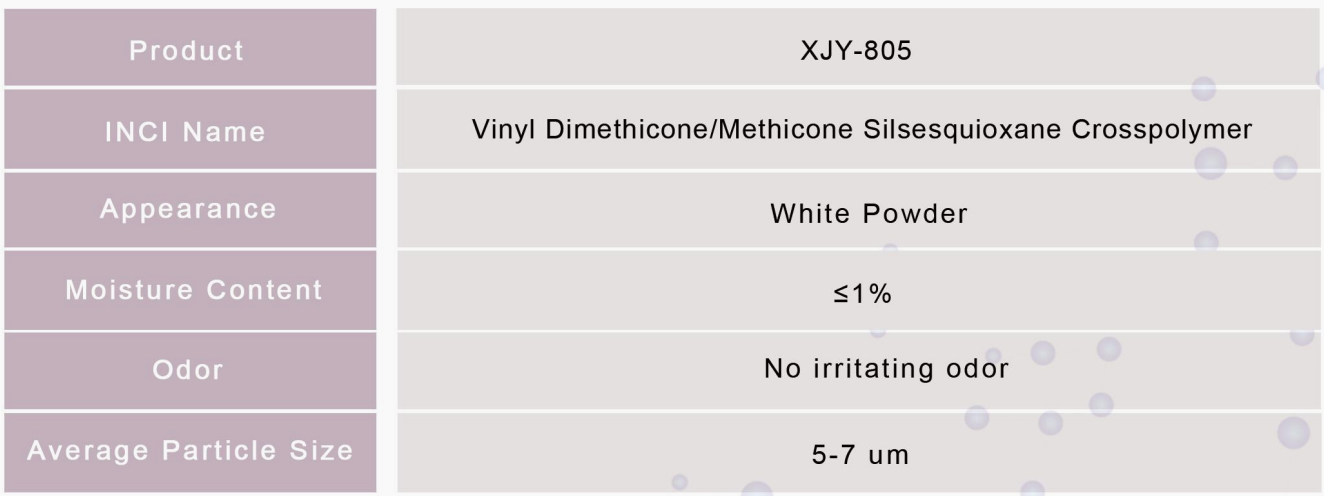
XJY-805 is Vinyl Dimethicone/Methicone Silsesquioxane Crosspolymer. Its vinyl dimethicone core and methicone silsesquioxane shell deliver softness, smooth touch, diffusion and skin adhesion.
XJY-805 is a white, no-irritating-odor powder with moisture ≤1% and 5–7 μm average size. Evaluate it in foundation, primer, concealer, powder makeup and skin care.
When Should Formulators Consider XJY-806?
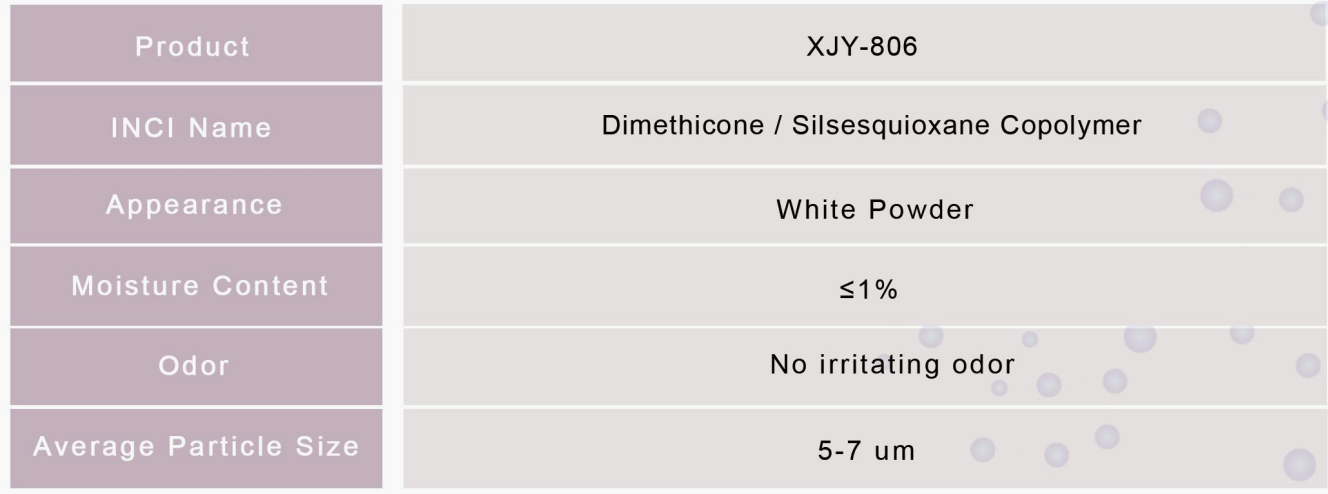
XJY-806 is Dimethicone/Silsesquioxane Copolymer, supplied as a white, no-irritating-odor powder with moisture ≤1% and 5–7 μm average size.
Consider XJY-806 when another copolymer chemistry is needed for softness, diffusion and adhesion. Select it by compatibility with oils, pigments, emulsifiers and processing.
XJY-805 vs. XJY-806: Which Silicone Powder Should You Choose?
| Selection Factor | XJY-805 | XJY-806 |
|---|---|---|
| INCI | Vinyl Dimethicone/Methicone Silsesquioxane Crosspolymer | Dimethicone/Silsesquioxane Copolymer |
| Appearance | White powder | White powder |
| Average particle size | 5–7 μm | 5–7 μm |
| Moisture content | ≤1% | ≤1% |
| Selection focus | Defined core-shell hybrid structure | Alternative copolymer chemistry |
Choose XJY-805 when its INCI and core-shell design match the brief. Consider XJY-806 when another silicone composite chemistry needs testing.
Neither grade is an automatic drop-in replacement. Similar size does not prove identical oil absorption, distribution, hardness, sensory profile or price-performance.
Which Beauty Products Can Use Silicone Hybrid Powder?
Applications include foundation, makeup primer, concealer, pressed or loose powder, lipstick, sunscreen, moisturizers and personal care products. The powders support smooth skin feel without replacing pigments or active skin care ingredients.
They can create a natural-looking skin finish across skin types. Claims about irritation, breakouts or healthier skin require finished-product evidence and cannot be inferred from raw powder.
How Should Formulators Disperse and Test Silicone Powder?
Decide whether powder enters the oil phase, pigment grind or powder phase. Use controlled mixing, limit agglomeration and review shear effects.
Test dispersion, viscosity, color, gloss, soft focus, spreadability and stability. Verify compatibility with silicone and organic oils, waxes and other ingredients before production.
Review specifications, COA, product packaging and storage. A sample trial provides better evidence than selecting by INCI alone.
Are Natural Silicone Alternatives Always Better?
Natural alternatives include squalane, plant esters, Isoamyl Laurate, Coco-Caprylate and natural oils. They suit organic beauty positioning but may not duplicate silicone slip, diffusion or stability.
“Natural,” “eco friendly” and “synthetic” are not safety conclusions. Natural cosmetics and conventional cosmetics both need review for health, performance and environmental impact.
Distinguish solid powders from volatile cyclic silicones. EU REACH restricts D4 and D5 in wash-off cosmetics and extends controls to other uses; every silicone does not share one profile.
Why Source Cosmetic Silicone Powders from XJYSilicones?
XJYSilicones, founded in 2003, manufactures silicone resins, functional fluids, powders, film formers and customized polysiloxanes for cosmetics and industrial applications.
Customers can request XJY-805 and XJY-806 samples, TDS, COA and batch documents to review quality, formulation fit, product packaging and commercial requirements.
Contact XJYSilicones to compare XJY-805 and XJY-806 in your makeup or skin care system and select a suitable silicone hybrid powder for the target skin feel.