 English
  Spanish
  French
  German
  Russian
  Japanese
  Korean
  Portuguese
 How to Choose the Right Peroxide-Cured Silicone Pressure Sensitive Adhesive
When selecting a silicone PSA, customers should not rely only on a peel strength number. Different factories may use different substrates, coating thicknesses, curing conditions, and testing standards. The same adhesive can show very different results under different processing conditions.
The following factors should be confirmed before product selection.
1. Coating Substrate
The first step is to confirm the coating substrate: PI, PET, glass cloth, PTFE, polypropylene, masking paper, release papers, metal, glass, or another material. Different substrates have a strong influence on peel strength. With the same adhesive and coating thickness, peel strength on PI film is usually lower than on PET film.
For low surface energy substrates, primer and surface treatment may be needed to improve anchorage. The final anchorage between the adhesive layer and the substrate will affect residue, delamination, high-temperature resistance, and long-term bonding strength.
2. Dry Adhesive Thickness
The thicker the adhesive layer, the higher the peel strength and initial tack will usually be. Thin coatings allow solvents to evaporate more quickly. Thick coatings are more likely to suffer from surface skinning, trapped solvent, bubbles, odor, or later-stage delamination.
This means dry adhesive thickness must match the solid content, line speed, and oven length. The coating design should allow the adhesive to reach full strength without trapping solvent inside the adhesive film.
3. Target Peel Strength
When customers provide a target peel strength, it is also necessary to confirm the testing substrate, test angle, test speed, aging condition, and tape structure. For high-peel applications, the solution often requires adjusting the adhesive grade, coating thickness, curing level, and blending ratio, rather than simply changing to another product grade.
Some silicone PSAs are designed for low tack or controlled tack. These low-tack grades may not be suitable for immediate bonding or applications that require a strong bond instantly after light pressure. Pressure-sensitive adhesives typically bond under light pressure, but their final adhesion and full strength can still depend on coating, curing, dwell time, and substrate surface characteristics.
4. Whether Pigment Is Added
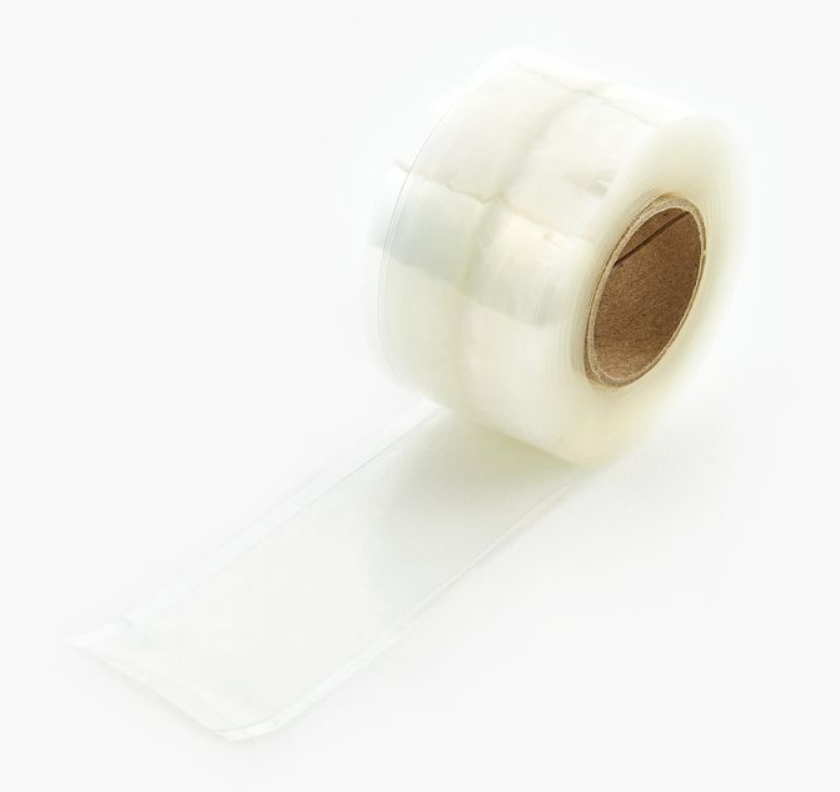
Transparent tape and PI tape usually do not require additional pigment. Green tape, red tape, and other colored tapes often require pigment addition. Pigments act as fillers and may interrupt the continuity of the adhesive layer, which can reduce peel strength.
For high-peel tape formulations, the potential loss caused by pigment addition should be considered in advance.
5. BPO Dosage and Curing Conditions
BPO dosage directly affects crosslinking density, adhesive hardness, initial tack, odor, and residue risk. If the dosage is too low, incomplete curing may lead to high-temperature residue, peel strength decay, or adhesive transfer. If the dosage is too high, the adhesive may become harder, the initial tack may decrease, and the odor may increase.
For peroxide-cured silicone pressure-sensitive adhesives, the BPO dosage should be adjusted based on the adhesive grade, coating thickness, oven temperature, and line speed. Small-scale and pilot-scale tests are recommended before mass production.
XJY-301 Series Peroxide-Cured Silicone Pressure Sensitive Adhesives
The XJY-301 series is a peroxide-cured silicone pressure-sensitive adhesive series developed by XJY Silicones for high-temperature tape and industrial tape applications. It can be used on PET, PI, glass cloth, PTFE, and other substrates.
Typical application directions include:
-
XJY-301-01: Low-peel PET tape, suitable for low-adhesion applications requiring softness and good conformability;
-
XJY-301-1: Low to medium-low peel PET tape, suitable for soft and conformable tape products;
-
XJY-301-5: Suitable for PET transparent tape and masking paper tape, with good transparency and wetting performance;
-
XJY-301-7: Suitable for PI tape and high-temperature green tape, offering good heat resistance and stability;
-
XJY-301-8: Suitable for glass cloth tape, PI high-temperature tape, and high-adhesion applications, with good cohesive strength;
-
XJY-301-10: Suitable for PI/PET high-temperature tape, with good compatibility with selected release films and fluorine-based systems;
-
XJY-301-12: Suitable for PI, PET, PTFE, and other high-temperature tape applications, balancing cohesion and conformability;
-
XJY-3001: Suitable for tape applications requiring low VOC and higher heat resistance.
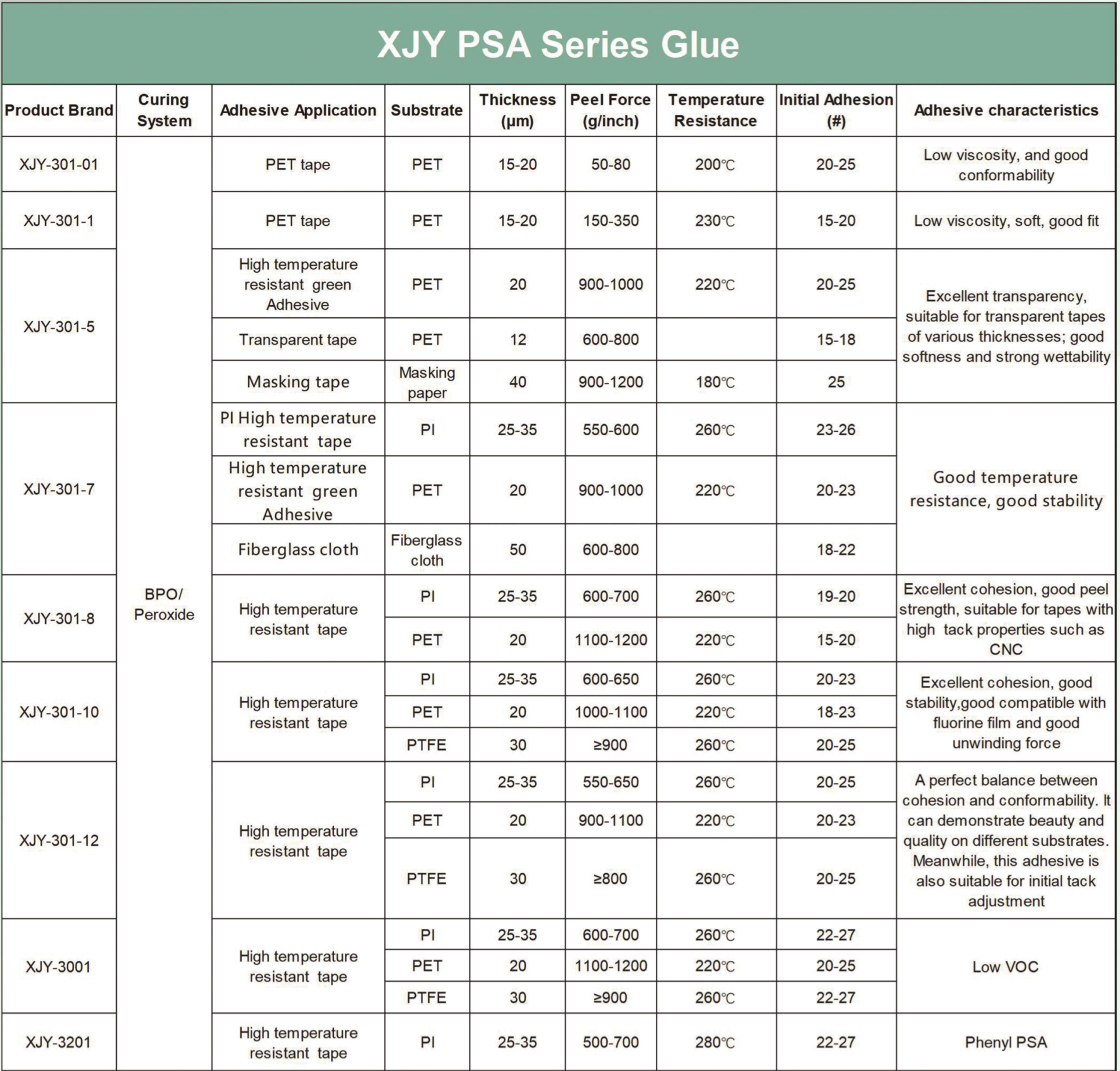
Actual performance is affected by substrate, dry adhesive thickness, curing agent dosage, oven length, line speed, solvent system, primer, and coating conditions. Customers are encouraged to provide complete coating parameters for more accurate product recommendations.
Common Troubleshooting Questions(FAQ)
Why Does the Tape Leave Residue After High-Temperature Use?
Common causes include insufficient BPO dosage, low curing temperature, excessive line speed, solvent residue, primer failure, or excessive adhesive thickness. It is recommended to first check the curing agent ratio, actual oven temperature, residence time, and solvent evaporation condition.
Why Is Peel Strength Different on PI and PET?
Different substrates have different surface energies, roughnesses, polarities, and thermal stabilities. The same silicone PSA usually shows lower peel strength on PI than on PET. Therefore, the testing substrate must be confirmed before judging whether an adhesive grade is suitable.
Why Are There Bubbles or Coating Marks on the Adhesive Surface?
This may be caused by fast solvent evaporation, excessive front-zone oven temperature, thick coating, or early surface curing. Suggested adjustments include lowering the front-zone temperature, optimizing the solvent system, adjusting solid content, and reducing line speed.
Why Does Peel Strength Drop After Storage?
Possible causes include incomplete crosslinking, insufficient curing agent dosage, solvent residue, primer problems, or unsuitable storage conditions. For low-peel silicone PSA products, curing stability is especially important. Optimizing BPO dosage and oven conditions can help improve long-term peel stability.
Why Choose Silicone Instead of Acrylic or Natural Rubber PSA?
Acrylic PSAs are widely used because they offer balanced cost and performance for many applications. Natural rubber PSAs usually provide good tack and quick stick, but they may be more vulnerable to heat, UV light, oxidation, and harsh outdoor environments.
Silicone PSAs are often selected when the application requires high temperature resistance, chemical resistance, weather resistance, bonding to low surface energy surfaces, or stable performance under extreme environmental conditions. Their main value is not only high adhesion, but also the ability to maintain adhesive properties when exposed to difficult temperatures, chemicals, sunlight, moisture, vibration, and aging.
Work with XJY Silicones for Silicone PSA Selection
XJY Silicones can recommend suitable peroxide-cured silicone pressure-sensitive adhesive grades based on the customer’s substrate, coating thickness, target peel strength, heat resistance requirements, and coating process.
To improve selection efficiency, customers are encouraged to provide the following information:
-
Coating substrate: PI, PET, glass cloth, PTFE, polypropylene, metal, glass, or other materials;
-
Target dry adhesive thickness;
-
Target peel strength and testing standard;
-
Whether pigment is added;
-
BPO dosage;
-
Solvent type;
-
Oven length, temperature zones, and line speed;
-
Whether primer is used and what primer system is applied;
-
Final application, such as Kapton tape, high-temperature green tape, glass cloth tape, powder coating masking tape, medical tape, electrical insulation tape, display assembly tape, or other industrial tape products.
With complete process information, customers can reduce trial-and-error costs, improve production stability, and achieve more reliable high-temperature bonding performance.
Choose your silicone pressure-sensitive adhesive Supply
For manufacturers of PI tape, PET high-temperature tape, glass cloth tape, pressure-sensitive tapes, and industrial masking tape, the right silicone PSA supplier should not only provide product specifications but also understand real coating processes and support troubleshooting.
XJY Silicones provides the XJY-301 series peroxide-cured silicone pressure-sensitive adhesives for high-temperature tape and industrial tape applications, helping customers balance heat resistance, peel strength, adhesion, cohesion, tack, anchorage, and coating stability across a wide range of demanding environments.
_1.jpg)